
Wine: More Dangerous than Cocaine, LSD and Mushrooms and Pot
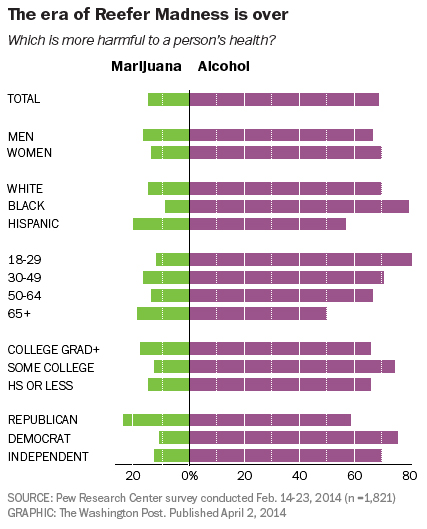 According to a new Pew survey reported on by the Washington Post, Americans believe that only crack cocaine, heroin and methamphetamines are more harmful than alcohol (including wine).
My question used to be, will the social acceptance and legalization of marijuana impact wine sales. Now my question is to what extent will there be a rising backlash against alcohol that impacts wine sales?
Just to be clear, the Pew survey showed that Americans now believe the following substances are LESS harmful to use than alcohol: cocaine, ecstasy, amphetamines, LSD, tobacco, and mushrooms.
Whether or not alcohol is, as the public seems to believe, more dangerous to use than anything other than crack, heroin or methamphetamines, what I think the wine industry really needs to think about in light of the public perception of alcohol is how wine can be positioned as a beverage of moderation, a healthful beverage and the beverage that isn’t necessarily used to simply get high. While wineries are prohibited from making any health claims concerning alcohol, non-wineries, journalists and associations are not prohibited from doing so. Based on this survey, these people might want to think about getting on board with a messaging campaign the shores up wine’s perception as better than to use than crack.
As I’ve mentioned before on this blog, I think it is very important to keep in mind that when compared to the commonly used drugs and particularly in comparison to non-medicinal marijuana use, wine can be consumed without any intent to get high. One can have a glass or two of wine with nearly no expectation of altering their perception. The same cannot be said about Marijuana and certainly can’t be said about cocaine, ecstasy, LSD, mushrooms or amphetamines. This is the fundamental difference between wine and marijuana.
I’d very much like to see some research that asks Americans, “Which is more harmful to use…Wine, Marijuana, Cocaine, Meth”. I’d want to know the perception of the harmfulness of usage of wine vs. marijuana. This information would be an important guide in any effort by the wine industry to shore up the reputation of wine versus other substances.
As you can see from the chart here that breaks down how various demographic groups responded to the question of which is more harmful (Pot v. Alcohol), it doesn’t matter how you slice it up. People believe alcohol is more harmful than pot. This is not good news for wine.
I highly recommend the column on this issue in the Washington Post as well as the write-up of the Pew Survey.


Not a bad column. I would, however, caution you against splitting off wine from beer and spirits in this endeavor. Firstly, there are plenty of problem drinkers whose intoxicant of choice is wine. Secondly, the overwhelming majority of studies showing a health benefit to moderate alcohol consumption make no distinction in how its delivered. Thirdly, and to your insightful point about alcohol consumption not necessarily being done to get high, the same can be said about a few beers watching the game or a martini at cocktail hour.
Shades of the late 1980’s, when alcohol was demonized as a dangerous drug until groups like Women for WineSense and, finally, Morley Safer on Sixty Minutes helped Americans understand the difference between moderation and abuse (remember the French Paradox?). It may be time to resume educating the public on that important distinction.
I suspect the responses to the Pew survey simply reflect the relative prevalence of alcohol consumption in the US. While about 60% of American adults drink beer, wine, and/or spirits, fewer than 10% of those abuse alcohol. The dangerous, illegal drugs cited are in the study are consumed by a small, hard to quantify part of the population – and there is no distinction to be made between moderation and abuse.