
Napa Valley’s Appellations Are Near Meaningless
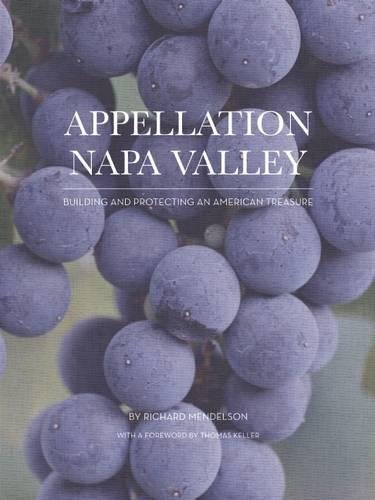 Richard Mendelson’s newish book, “Appellations Napa Valley” is a fantastic tome. Written in a personal, first person voice that reflects Mendelson’s vast experience with the development of the Valley’s various sub appellations as well as his obvious and genuine affinity for this part of the world, the coffee table-style book is a unique and necessary addition to the Napa Valley Wine bibliography.
However, the subject of the book brings up an important question that has been asked before: Do Napa Valley’s various sub-appellations have any real meaning for consumers beyond being lines on a map?
Let me put that question another way. Should an experienced consumer of Napa Valley wine be able to easily tell the difference between an Oakville Cabernet Sauvignon and a Rutherford Cabernet Sauvignon? What about between a Saint Helena Cabernet Sauvignon and an Oak Knoll Cabernet Sauvignon?
Maybe I’m going out on a limb here, but I’d be willing to bet that some of the most experienced Napa Valley palates couldn’t not successfully and consistently identify the AVAs from which a selection of different Napa Valley Cabernets originate. And if they can’t do this, what are the odds that Jimmy Bigcellar from Dallas can identify the AVA of different Napa Valley Cabernets?
Mendelson himself is well aware of this critical deficiency of the Napa sub-AVAs and AVAs in general when he exposes the most common criticism of AVAs: “They are marketing devices that impart no useful information to the consumer.”
He correctly identifies the problem with AVAs. He further appreciates this deficiency when he goes on to speculate about potential futures of the AVA system. Mendelson spends his most important chapter looking at the potential for the ruling federal agency, the TTB, to regulate the real sources of verifiable and identifiable terroir, the designated vineyard, as well as speculating on how vintners and growers in different AVAs might one day voluntarily layout growing and production rules. Mendelson writes:
“I wouldn’t be surprised if someday a vintner-grower group in the Napa Valley were to adopt a voluntary, private program covering grapegrowing and winemaking practices and a tasting of the finished wines as part of a collective effort to enhance the expression of the AVA’s most distinctive wines.”
Mendelson identifies the only practical way an AVA in Napa Valley will ever provide consumers with real meaning where the character and style of its wines are concerned. I would, however, be somewhat more surprised to see this happen on any significant scale than he is.
The only reason that the wines of the AOC system in France have any consistency is that there are very specific rules governing how an AOC labeled wine is made and how its grapes are grown and which grapes are used. No such rules exist in America, let alone Napa Valley. Mendelson correctly identifies the reasons this has not occurred in the U.S. when he notes that, “For a New World country that is still actively exploring its terroir and developing traditions and culture, rigid appellation controls run the risk of stifling innovation and impeding product development…While it is not in the Amerian DNA to dictate to farmers what grape varieties are to be planted where or to control the art of winemaking, it is part of our culture to experiment.”
In my view, Napa Valley has accumulated so much renowned in spite of its sub-AVAs. I suspect there is not a single wine made in Napa Valley that would be less successful and less famous if it removed the sub-AVA designation on its label and simply put the “Napa Valley” AVA on the label. That isn’t to say that some AVA’s grapes demand more money. They do. But consumers don’t know this. Screaming Eagle would still be “Screaming Eagle” whether it put “Oakville on the label or not. Colgin is Colgin despite the fact that it does not put sub-AVAs on its label.
Today, Napa Valley AVA’s amount to two things: lines on a map and marketing objects around which various marketing stories can be told. They tell consumers very little about what the wines made from grapes grown in those AVAs are likely to taste or smell like.
For the experienced and obsessed wine drinker, the key to understanding Napa Valley wine is to focus on the producer and the style they choose to pursue and, secondarily, to focus on designated vineyards and their specific terroirs and the characteristics they consistently lend to wines produced from their grapes. This is not to say that all Napa Valley sub appellations are simple lines on the map. Some have more meaning than others, for sure. But this does not take away from the reality the meaning is invested in producers and vineyards.
On the other hand, I highly recommend Richard Mendelson’s new book on Napa Valley appellations. It is such a real pleasure to read and is stuffed with good writing, good history, and good analysis.


Mendelson is both a significant contributopr to the necessary expansion of the sub-AVA system in the Napa Valley and one of the people who therefore must also stand accused of helping to screw things up.
That he still defends the very much faulted arrangement that allowed mid-valley AVAs to be identified by commune (town lines) as opposed to wine commonalities is a big strike against him. He and the folks who agreed to this bastard of a compromise knew better and yet let it ride for marketing reasons, not wine commonality reasons.
But, folks in the Napa Valley do know better. Witness the most recent tasting put on by the Rutherford folks in which wines were chosen to represent subsets of the Rutherford AVA. They know, as even Jimmy Bigcellar knows, that the West Rutherford Bench produces identifiable wines that are significantly different from the wines grown across the valley near the Silverado Trail. While it may not be easy to separate West Rutherford from West Oakville, it is pretty easy when presented with representative examples of each to tell them apart.
So, full credit to Mr. Mendelson for the good that he has done, but demerits for the damage that he has helped to foist on the intent of the AVA system,
Hi Tom, If you haven’t tried it and have a chance, I would recommend the blending experience at Conn Creek, a great way to taste wines from (nearly) every ‘sub’ appellation in Napa, get a sense of how different they taste (not that different?), make your own blend … etc
Yes, it is a marketing ploy, just as the appellation systems of european countries are marketing ploys. Marketing, you know, that thing you do so you can sell your product so that you can earn income so that you can still actually be in business next year to make the wine again, so that all the wine drinkers have something to drink while they argue about how screwed up wine classifications are.
How is any of this a bad thing? Especially when wine drinkers love to have it, to connect what they are experiencing with a place that it came from, even if they can’t tell by taste that it’s any different from some other place nearby.