
Wine Needs Curmudgeons Now More Than Ever
 Jeff Siegel (aka “The Wine Curmudgeon“) is celebrating his 8th year writing about wine at his blog. Jeff’s is a great blog and despite not agreeing with him on occasion, I’ve enjoyed reading “The Wine Curmudgeon for all eight of the years he has been toiling away attempting to expose the world to low-priced wines (his reviews are almost always of those wines that are $20 and under).
But Jeff is in a mood. Recently, he bemoaned with a heavy literary sigh that “Big Wine” is taking over, shoving out the good, high value, lower priced wine he has loved to drink and to recommend and replacing them with fewer brands selling “fruity red wine with soft tannins and chocolately oak” that he just can’t stand.
It’s all a product of mergers and acquisitions, Jeff explains, that will result in a two tier wine marketplace:
“There will be two markets for wine…In the first, called the mass market, Big Wine will make as many as four out of every five bottles sold in the U.S — competent though often overpriced grocery store plonk with little varietal character and designed to appeal to specific demographics, the way laundry detergent and yogurt are. In other words, “smooth” wine. In the second, called the luxury market, what’s left of the traditional wine business, both producer and distributor, will sell wine costing more than $20 to people who can afford to buy it, and whose spending will keep the dwindling number of traditional retailers and small distributors in business.
It’s easy to understand why Jeff wonders whether it’s even worth continuing to try to publish a blog about “value wines”.
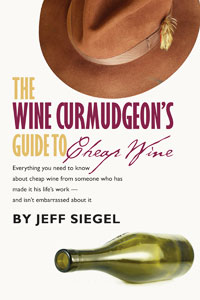 But I want to encourage Jeff to continue to focus on value wines, wines that taste great and don’t cost an arm and a leg by telling him the good news.
First, there has always been a two tier market where the vast majority of wine bought and consumed is sweet and syrupy and purchased in grocery stores and drug stores and a tiny number of wine drinkers choose to spend much more on much more interesting wines that tell real stories of real places and don’t rely on sugar for structure and taste. The vast majority of Americans drink wine to taste something sweet and alcoholic while they take on a comforting buzz. That’s the demand the grocery and drug store wines meet and always have met.
Second, Jeff can still find very good value wines, but he is going to have look at the $25 level. You certainly can find very good imported wines at this price, but you can also find excellent California, New York, and Washington wines at this price. However, you are going to have to be willing to go to the winery or go to good retailers or have the wine shipped to you from a really good retailer—of which there are many who will ship wine to you.
Third, while there has as Jeff explains been consistent consolidation among the big wine brands, it is still true that the vast majority of individual wines produced in the United States are made by small and smaller family owned wineries located in California, Oregon, Washington, Idaho, Illinois, Missouri, Arizona, Texas, New York, New Jersey, etc, etc, etc.
Worrying about consolidation among the big wine brands makes no sense. And if you are a discerning wine drinker, you could care less. There are more wines and wine brands and wineries on the market today than ever before in the history of the world.
If you want to worry about consolidation, worry about wholesaler consolidation and the state mandated three-tier system. After the recent merger of Southern Wine & Spirits and Glazers and the merger of Wirtz Beverage and Charmer-Sunbelt, we can observe that only four wholesalers control 60% of the wine distribution business—A disaster for the small and medium-sized winery (meaning 99% of all wineries in the United States).
We need the Wine Curmudgeon today more than ever because today there are $25 wines available to consumer than ever before. However, Jeff’s work needs to center not only on identifying these wines, but also in teaching his readers how to obtain them, how to have these wines economically shipped to them from out-of-state wine stores and wineries, rather than assuming readers will find these wines at their local stores.
On the occasion of the 8th anniversary of the Wine Curmudgeon blog, Siegel warns we are witnessing “The End of the Wine Business As We Know It.” It’s not true. What we are witnessing is the logical conclusion of the wine business as it was originally designed in the 1930s at the end of Prohibition. It was predicted then that members of the industry would use their influence to game the system to their advantage. This has happened.
But at the same time there has been a reaction to the distribution monopoly using their state-granted weight to pummel the wine drinker into submission, reduce the number of SKUs they hand and increase their power to control both producers and retailers. That reaction is direct shipping from wineries and from retailers. And that’s the channel toward which wine drinkers looking for good, great and interesting $20-$25 wines must be guided by our dedicated Wine Curmudgeons.


Aside from the fact that The Wine Curmudgeon for me has been and always will be Jerry Mead who used that moniker was Jeff was in knee pants, the notion of a voice willing to speak difficult truths will always be welcome.
But, that said, Mr. Siegel is so very wrong about the death of the wine industry. if anything, it has become more diverse with lighter styles emerging all over the place, with imports also offering a wider swath of choices–and note, please, that modernization has lifted many regions of the world out of the doldrums and into the spectrum of clean and presentable wine.
As for the range of priceworthy wines, it is true that the top varieties are getting pricey, but then, when were they not. Yet, in our tastings at Connoisseurs’ Guide, we continue to unearth great values from big and small producers alike–and those values are not limited to soft, chocolaty wines.
Charlie, what are “knee pants”?
Charlie, There is only one true “Wine Curmudgeon,” and it ain’t johnny come lately, mr gray. 🙂 I’m with you on the abundance of excellent wine in the $20 range, unfortunately there is none that is “Produced and Bottled By” the winery on the label.. So the wines referred to here are the reasonably priced “Cellared/Vinted By” blended bulk wine, (“not that there’s anything wrong with that”). I would like to know who the small producers you’re referring to that “produce’ and sell wines in the $20 to $25 range. I don’t think the economics work considering the cost of land, grapes and production.
Bill–
Mr. Siegel did not define the value market as only consisting of “small” producers, and, thus, my remarks take a broader view than the limits you have suggested.
We can disagree on his intent, but I have reread his comments as interrupted by Tom Wark and I see nothing in them that would disqualify Dry Creek Vineyards or Rodney Strong, admittedly not “small” but not top ten either if my memory is right.
He is apparently unaware of wineries like Blacksmith, run by Matt Smith, who otherwise works at Rock Wall Cellars. Matt’s wines total just a few thousand cases but most sell for under $20 save for his Stag’s Leap CS at $40 and still a bargain because it is very good.
Also, I do not see that “Vinted and Bottled” wines necessarily cannot be included in the list of bargains. Castle Rock continues to find high quality wine that it can bottle and sell for closer to $10. Not every wine it offers meets the Connoisseurs’ Guide standard for our GOOD VALUE designation but some do.
By the same token, McManis, a big producer of Central Valley wines from a “cooler” part of that region often makes reliable wine for $10.
Here is a point on which I assume we agree. With the prices of wine going up, there will be fewer wines under $20 that are GOOD VALUES. But, the market already knows that. People will pay $25 and $30 for CS and PN more readily than they used to just as they pay more for housing, more for movies, more for turkeys, more for cars, etc.
Where I separate from Mr. Siegel is not in his assessment that value products are more expensive than they used to be and that what were once value prices in general have increased and thus his view of the world needs to expand. There are still values out there, and many more than I have listed.
His is not a new complaint. When I first started writing about wine, Italian Swiss Colony Zinfandel was $1.49 and was almost entirely made from Sonoma County field blends.