If You Only Read One Wine Book This Year
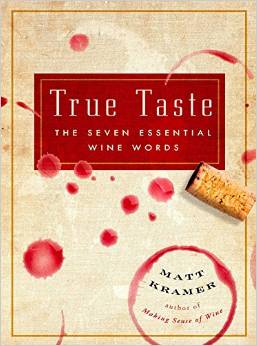 Matt Kramer’s latest book (really not more than a long, concise, finely argued essay) is subversive. While at once a bare knuckled take down of the now well established “flavor-descriptor-as-tasting-note” mode of wine review, True Taste: The Seven Essential Wine Words is also a manifesto for the return to values, judgment and discernment in both wine writing and wine reviewing. And it is a book that every wine writer, every wine industry participant and every true wine aficionado needs to read because it is one of the most important and insightful wine books to be published in the past 20 years.
True Taste is the culmination of Kramer’s 40 years of writing about wine. And the book reads like something one would need 40 years of drinking wine, tasting wine, evaluating wine, discussing wine and thinking about wine to produce. Those 40 years of experience have provided Kramer with a unique view of a transformation in wine writing and evaluation that he believes has taken us all astray. And he’s right.
Boiled down, Kramer’s plea is that we move aside the obsession with focusing on flavor identification and descriptors when we evaluate wine because the descriptors actually tell us very little about the quality of the wine or about the most important thing: our judgment of the wine: “Flavors descriptors have nothing to do with judgment. What you can find doesn’t necessarily correspond to what you conclude…Too many tasting notes now offer little more than a string of fanciful flavor descriptors with the judgment revealed only in the score itself—a numerical ‘thank you ma’am” after the more energetic ‘slam , bam’ of the flavor descriptors.”
Kramer is looking for thoughtful judgment in wine reviews. He wants a return to insight and, more importantly, to an embrace of subjectivity after too many decades of the pretense of scientific objectivity in wine writing in the form of descriptors and numbers.
The first two chapters of True Taste are the most important, with chapter number two making the most  important point in the entire essay: great wine writing happens when insight is delivered as a result of the synthesis of experience and thought. And one thing is for sure. One does not expose themselves to insight by reading a string of flavor descriptors.
The bulk of True Taste is given over to a discussion of what Kramer believes are the most important concepts and ideas to keep in mind as one evaluates a wine: Harmony, Texture, Layers, Finesse, Surprise and Nuance. It is by focusing on these concepts in the evaluation of wine that the taster (and writer) can uncover insight, what the wine is about and what might make it significant or simply interesting.
Although Kramer provides the reader with definitions behind these very subjective terms, they remain…subjective. And this suits Kramer just fine. The cry he hears (for him, too often) that wine tasting is just subjective and a “good wine” is one that you like is the least one can say about a wine and nearly not worth saying—and certainly not worth writing. He will argue that wines that possess “Harmony”, “Texture”, “Layers”, “Finesse”, “Surprise” and “Nuance” in one degree or another are the wines that will inspire us and provide meaning to our pursuit of aesthetic truth, if not simply pleasure.
The way Kramer moves through these ideas and explains in a precise, convincing, and an easy-to-read way why they are the roadway to understanding what might be special, great or impressive about a wine is nothing less than a tour de force of wisdom and vision. Had this book been available to me 25 years ago when I first entered the wine business I would have been a far better advocate for my clients than I am today…as well as a better wine taster.
Finally, it’s notable that the way in which Kramer addresses the obvious issues of style and what makes a wine fine—issues that must be addressed in such a book—are done in a delicate and ecumenical way. He’s not trying to start a revolution. But he may be trying to nudge one along. After all, just read the title.
The vast majority of wine books are compendiums or references or (to my weary eyes) attempts to explain why wine really is just so simple. It’s rare to see published a wine manifesto. This is an important work that deserves being read more than once. Though thin, it’s dense with ideas and insight.
True Taste: The Seven Essential Wine Words
By Matt Kramer
Cider Mill Press (2015)


Tom,
On occasion, you are the on the receiving end of blog commenter brickbats.
Not today.
Good job on conveying the sentiment and passion behind Kramer’s newest tome.
Bob
Maybe I’ll get the book, but I’m already wondering: if you accept that atse is subjective, without some sort of codification, how does one propose to determine for others “Harmony”, “Texture”, “Layers”, “Finesse”, “Surprise” and “Nuance”?
If I had tasted a gooseberry I’d know what someone means when gooseberry is used as a descriptor. I’m unsure how many people can taste, say, Surprise or Harmony.
I’d really love a book that tells me why the aesthetic desires and subjective talents of others is important to my taste. That would be a best seller among pedants like me…