Locating the Moral High Ground in the Wine Industry
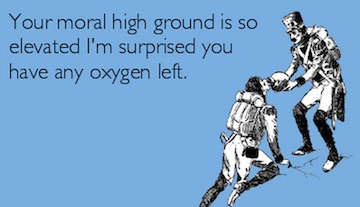 There must be word or phrase for that rare occurrence when a business or organization’s financial interests are always located at the summit of the moral high ground. If there is no word or phrase for this phenomenon, there ought to be — how else to talk about and understand the role of the wine wholesaler.
This rare confluence of morals and financial interest were on display at the recently completed Annual Convention of the Wine & Spirit Wholesalers Association (WSWA) in Orlando, Florida. There WSWA President Craig Wolf stood on a large, well-lit stage and told the attending wholesalers from across the country that the WSWA would bravely “follow the better angels of our nature.”
Coincidentally, these angelic guides just happen to lead Mr. Wolf and WSWA directly to an ardent defense of the three-tier system, which has evolved over the past 80 years into not a rational and fair alcohol regulatory system but rather a system perfectly designed to protect wholesaler profits, margins and power.
While standing on stage in Orlando, Mr. Wolf explained that the greatest threat to the Angelic System of Three came from retailers that are “applying their considerable resources in an effort to monopolize the retailer marketplace, replace or limit the role of the wholesaler and ultimately dictate the terms of trade to the supplier tier.”
How is this happening? No doubt as a result of retailers taking their lead from the worst angels of their nature who are located at the base of the moral high ground.
It turns out, according to Mr. Wolf, that retailers who want to be able to own more than one store in state or be able to buy directly from producers rather than from wholesalers or who want to sell to consumers located in states other than their own are the devils that will upset “balance among and within the tiers.”
Coincidentally, it is in the financial interest of wholesalers that retailers not possess the buying power that comes with owning more than one store. Coincidentally, it is in the Financial interest of wholesalers that retailers not be able to purchase product directly from producers, but are rather forced to buy from wholesalers. Coincidentally, it is in the financial interests of wholesalers that retailers not be able to sell wine to consumers in states other than their own.
Again, there must be a word or phrase for this phenomenon of locating one’s financial interest at the top of the moral high ground.
This of course is not the first time WSWA has discovered that the interests of wholesalers happen to accompany the same space as moral righteousness. In the battle over winery-to-consumer shipping before and in the wake of the Granholm v. Heald decision, WSWA assured anyone who would listen that wineries shipping directly to consumers would lead directly to children dying from drunk driving accidents, states would fold under the weight of lost tax revenue and alcohol regulators would be unable to cast a net over the thousands of wineries shipping into their state. In opposing direct shipments, the WSWA was only following the better angels of their nature and looking out for the industry and society. It was only coincidental that the financial interests of wholesalers coincided with this desire to protect society.
What IS the word for this confluence of moral fortitude and financial interest??
In the end, Mr. Wolf promised those wholesalers in attendance that WSWA would continue to “follow the better angels of our nature and continue to advocate for policies that encourage balance among and within the tiers.”
Wolf explained that while he wants all wine retailers to be successful, WSWA must oppose any actions on retailers’ part that are “designed to alter the balance of power between the tiers” and give any one of the three tiers too much power.
What does this “balance of power” look like?
-Requiring that wholesalers get a cut of every alcohol transaction
-Requiring that retailers not sell wine outside their state
-Requiring that producers only sell to wholesalers, not retailers
-Requiring that retailers only own a single store
What an astonishing coincidence it is that when a “balance of power” among producers, retailers and wholesalers is struck, it is the wholesalers that benefit financially while society, according to Wolf, is protected from a descent into moral and regulatory chaos.
There must be a word or phrase for this astonishing coincidence.


“There must be a word or phrase for this astonishing coincidence.”
Three immediately come to mind: “self-deception”, “lack of self-awareness”, and “chutzpah”
Tom,
I am working on an articles titled “Wine Politics” focused on the wine distribution issues in New York. You thoughts would be appreciated.
how about “greed”?
The WSWA is a wholesaler paid for trade association and lobbying group. What do you expect them to say, put us out of business? I am not an apologist for them, but your ongoing screed against them is frankly tiresome, and no longer original. This is who they are, this is how they are, and this is how they are going to be. Any winery or potential winery should be aware of this fact, moral or otherwise. I see where some wineries, e.g Viader and Iron Horse have redirected their marketing efforts to direct to consumer, rather than putting all their eggs in the immoral basket
Tom:
My apologies for boring you. It was not my intent. However, it just occurred to me that the idea that the high ground could match up perfectly with financial interests seemed like such a rare thing, it ought to highlighted.