The Contours of My Belly Button
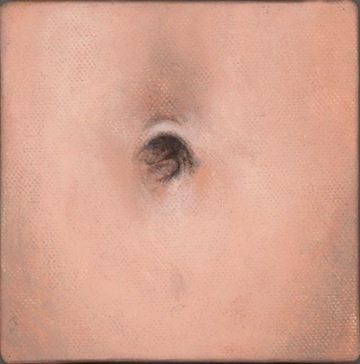 Do I and others who publish their own site about wine know far too much about the contours of our navel? Have we explored its ins and outs ad infinitum? This is the gentle charge that was made in a number of ways by at least four different commentators in this recent post here at FERMENTATION about the distinction between “blogger and “journalist”.
I wanted to address this charge of “blogger navel gazing” because it comes up so very often and when it does come up and when we are accused of writing about ourselves too much it is usually a charge that attempts to convey something along the lines of “get over yourself.”
Getting over myself is unlikely, but there is a response to the charge of navel gazing.
I think that one of the most important reasons that “opinionators” or publishers like me do tend to contemplate our work so seemingly often is because what we do on these kinds of sites is still not only new, but is also the most important change to hit the public square at least since the invention of the telegraph.
Electronic self publishing that allowed easy and inexpensive commentary and perspective from anyone and that had the potential to reach anyone on the globe, dismantled the walls between on the one hand the gatekeepers who for centuries shaped the opinions and perspectives of the public, and everyone else on the other hand. I cannot over emphasize the importance of this revolution and neither can anyone else.
I remember a world, barely, when the outer edge of ideas concerning presidential politics, biblical scholarship, economic theory, civic planning, home cooking and wine were drawn and defined by a very small group of publishers and broadcasters who possessed resources far beyond those of the average person and that allowed them to become part of the debating society that shaped opinion on every issue under the sun. The power of this position was enormous. Contemplate for a moment the impact of a person in Dallas or Boston or San Francisco or Tallahassee sitting down at 5:30pm in the evening and having to decide between three and only three potential sources for their evening news. Or consider impact of people getting up in the morning in Los Angeles, Bismarck, St. Louis, Washington, DC or Phoenix, walking to their driveway and picking up one of only 2 or 3 choices of local daily newspapers available to them.
The power possessed by those who controlled these limited number of information channels was enormous for the simple reason that they were limited and the expansion of these choices resulted only from someone of great wealth deciding to weigh in by producing another outlet.
In 1990, if I wanted to stay informed on a regular basis about the contours of the wine industry and the wine world, I had roughly ten sources that would mail me something comprehensive on a monthly basis. There were perhaps two sources that would fax me something on a weekly basis that examined the business of wine. That was my world.
Today, anyone can begin publishing daily about the wine industry at little or no cost and anyone anywhere in the world can read it. The perspectives, opinions, and positions concerning wine and the wine world have exploded exponentially in just the past 15 years. The game is changed.
So for those of us who are participating in this game and publishing our own, personal, information outlets, it should be no surprise that we, among all others, are very interested in the meaning of what we are doing and the impact of what we are doing. This is why we “wine bloggers” tend more often than not to survey the contours of our belly buttons. The curves, wrinkles, depth, and width of those belly buttons and the residue we find within them, together provide us with an explanation for the meaning of the information revolution in which we are participating.
And of course, it is a feature of this revolution that we need not care about the cost of the paper, ink or delivery logistics entailed in publishing a map of our belly button. We risk only alienating any readership we may have developed. And Lord knows, this is a risk to which very few of us navel gazers have given much thought.


Is it possible, Tom, that barring gossip and effusive opinion, there may not be enough information available to support the number of wine bloggers?
I don’t subscribe to the idea that because something exists it is automatically a good or important thing. The same hype applied to social media and the Internet was applied to early television. We can see where television has gone; on its way there, it did little to wipe out the need for the so-called gate keepers. If anything, TV made it more important that some other entity watched over information’s trajectory while the medium gave itself over to advertising and lowest denominator entertainment.
it’s always a good thing to remember the phrase: plus ça change, plus c’est la même chose.