Impressions of the Natural Wine Movement
 I just can’t help but wonder how typical of the average active wine drinker is Lettie Teague’s assessment off her exploration into the meaning and taste of “Natural” wine. Teague, a respected and award-winning wine writer for the influential and widely read Wall Street Journal, investigated this nebulous category of wine and concluded the following:
“My tasting didn’t lead me to any profound conclusions, although it did lead me to believe that some natural winemakers are more talented than others. What bothers me most about natural wine, beyond the off-putting categorization and the (unproven) specter of biogenic amines, is the ideology that its true believers espouse. I want a wine that simply tastes good; I don’t need to know What the Winemaker Believes Most. I wouldn’t buy a wine just because it’s purportedly natural any more than I would shun one because it’s not.”
Surely the response to Ms. Teague’s article by the champions of “Natural” wine will be:
“Some people want more than you do, Ms Teague. Some people want a wine that tastes good, tastes of its place in the world, isn’t grown and made in ways that harm the environment, doesn’t threaten the drinker with potential damage to their health, doesn’t encourage a monolithic sameness of character as so many wines do, avoids contact with technical production procedures and techniques with scary names, and doesn’t try to put wine on a materialist pedestal that crass collectors and possessors crave”
The champions of “Natural” wine have been demanding quite a bit of this category.
Moreover, these champions and their cohorts who actually make the wines ask for a different set of things from the wines they market as “natural.” That, of course is both problematic to the average wine drinker who likes to understand a thing at least half way and perfectly fine to those who are merely happy to see the powerful and expressive term “natural” do is work in the marketplace.
What’s really interesting about Teague’s Wall Street Journal exploration of “Natural” wine is that it gets stuck trying to understand and explain what must be done and not done to a wine in order for it to be deemed “natural”. Naturally, she is confronted with the primary conundrum of this manufactured marketing term: there is no agreed definition or certification of what a winemaker must or must not do in order to be rewarded with the right to appended the adjective “Natural” to their “wine”.
Some added sulfites are Ok. No, added sulfites disqualify you.
The grapes must be grown in a certified organic way. No, they must be grown biodynamically.
No barrel aging for natural wines. Some barrel aging is ok.
Lettie Teague is a thoughtful writer. Because of this I know that had her editors given her adequate space, she eventually would have gotten to the heart of the “Natural” wine matter: What is actually trying to be achieved by the champions of natural wines and those vintners who either self identify with the category or who have been herded into the category. What does “Natural” wine mean?
For the most powerful and profound and most entertaining discussion of this issue, one must turn to Clark Smith’s 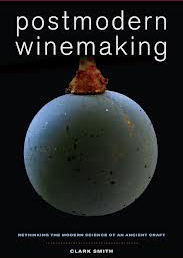 recently published book, “Postmodern Winemaking”, and particularly to its “Part Four: Philosophy”
Smith is well-known within the wine trade as a thoughtful, philosophical, excitable and iconoclastic winemaker and consultant. He owns WineSmith Cellars, a noted consultant and is an adjunct professor at Fresno State University. He was also the founder of the world’s largest wine technology provider, Vinovation, where he championed the judicious use of scary technological processes such as micro-oxygenation and Reverse Osmosis for the purpose of alcohol removal and the correction of volatile acidity in wine, two technologies that nearly all “Natural” wine champions view as heretical.
One of Smith greatest contributions to the debate over “Natural wine” centers around this observation:
“Why, after a decade of harangue, has the [“Natural” wine] movement failed to formalize standards? My belief is that it isn’t a movement at all. The Natural Wine “movement” is instead an uneasy coalition of strange bedfellows whose agendas can’t all be satisfied by a single set of winemaking rules.”
 If you want to understand the 8 constituencies that Smith identifies as the bedfellows that fall into the “Natural” camp, you must go buy “Postmodern Winemaking” where he not only describes each, but very specifically pulls out and identifies each constituencies’ primary interests. It is a fascinating discussion that deserves careful attention paid by anyone interested in this topic or for that matter any number of the most controversial and animating debates in contemporary winemaking and wine appreciation.
What is not fully explored in either Teague’s Wall Street Journal article nor in Smith’s “Postmodern Winemaking” is what I believe is the profoundly important semantic character of the “Natural” wine movement. What Teague implicitly questions and what Smith understands fully is that the wines falling under this movement’s semantic banner are most certainly not “Natural” in any meaningful way. And yet, this word is fully embraced to describe a category of wines that as we’ve seen are indefinable in any meaningful way.
This means that this term is not used to describe these wines in the meaningful and specific way that the terms like “Sweet”, “Napa Valley”, “Low Alcohol”, “Red”, “White”, “Syrah”, “Vinifera”, “Botrytis”, “Organic”, “Biodynamic”, “Sparkling”, and other words of real meaning are used to communicate something specific and useful about a wine.
 This fact leaves the term “Natural” as nothing more than a meaningless marketing term. But there is something much more sinister than “Natural” being just an arbitrary marketing term. The word implies strongly (and sometimes explicitly) that wines not falling under the heading of “Natural” are “Unnatural”. The implication of being an “Unnatural” wine are simply not good…in any context. It implies they are plastic, constructed, inauthentic, unhealthy, industrial, “frankenwines”, all things that apply to very few wines.
The semantic implications of sticking to the use of the term “Natural” should be clear to anyone: it leads to a necessary denigration of wines that do not earn their way under the umbrella of “Natural”. And if you take a close look at the diverse literature of the champions of “Natural” wine you’ll see example after example of denigration heaped upon non-“Natural” wines in many quarters that is rarely disclaimed by the category’s champions when brought to their attention.
Finally, the adherents to and champions of this still meaningless category of wine understand the implications of the use of the term “Natural”. They understand that it describes nothing. And they understand that it naturally leads to denigration of most other wines. And yet, they continue to use the term because it is a word that has such positive associations for those that want something “Natural” because they believe it is something that must be better for their bodies and their world. In other words, many champions of “Natural” wine are willing to knowingly hoist up a false flag for the purpose of marketing their products and promote an agenda.
I’m no winemaker. Nor am I a grapegrower. However, I am a marketer and a writer. And I know a manipulative and arbitrary use of words when I see it.


Tom,
I agree with many of your points and am no fan of terminology. The only thing I would take issue with, I think, is Clark Smith’s definition of a “movement.” An “uneasy coalition of strange bedfellows” is how I would, when studied closely, define most movements. From the Tea Party Movement to the Occupy Wall Street Movement….most are made up of such an uneasy coalition (hell, given the recent holiday, it is worth pointing out that even New York State abstained in voting for Independence during the Second Continental Congress).
Do you think all members of a group have to be in complete agreement on all points for something to be a movement?
Adam Lee
Siduri Wines
I’d like to petition TTB for a formal definition of “natural” with regard to wine labeling. Pretty much all federal agencies have to accept citizen petitions for rulemaking. If it got to the preliminary rulemaking stage, there would be public comment. Interested parties could put themselves on the record as to their thoughts on an appropriate definition. Should a definition be created, wineries would have to abide by it in order to put the word on the label.
It’s unlikely TTB would touch it, but that in and of itself would pretty much codify the lack of definition.
Tom, outside of certain sales and marketing circles, there’s almost no material out there about natural wine. 99.9% of consumers in Montreal, Omaha, Philadelphia and other non-wine producing areas have never heard of this controversy, yet you and other bloggers beat the living hell out of it–you are by far the greatest source for opinion on natural wine.
Why? Other than fodder for the relentless mill that is a blog, and a desire to correct the wrongly-minded, what is it about natural wine that keeps inflating it in critics and observers minds? Just being wrong isn’t a sin (if they are–frankly I don’t care. I choose wine on a hedonic scale, not a philosophical one) and just being ignorant or fearful of science isn’t one either, so I’m very curious as to why y’all in the establishment care so deeply that you keep bringing it up over and over again.
Ugh. Product terminology is so fraught to bull poop. Did you know Budweiser is considered a premium beer? Not by anyone I know there days. Natural has been twisted beyond belief by big foods that it’s almost meaningless. 8 of 10 people I’m in contact with looking for organic are thinking no sulfite. And when I show them an organically grown, low/no sulfite red from the Loire Valley their head explodes.
Considering there is so little natural wine available, retailers/restaurants that know and care about these wines will get them to the right hands.
I’m a fan of “Authentic Wine:…….” as Jamie Goode and Sam Harrop put forward in their book of the same name, I say leave “Natural” to those who want to spend more time explaining (rationalizing?) the name than drinking wine……….
Tom, Your comments, and Ms. Teague’s are interesting, but “natural” means nothing. One can have a jar of swill that is “a natural, barrel aged, aged vine, estate, utilizing 100% hands off wine methods.” What this means is… nothing at all… Of course, it would have to have been in a barrel of some sort for a few minutes, but other than that, the terms mean nothing – “old vine” and “estate grown” are a bit more specific. And your final sentence is absolutely perfect – this is sales and marketing…
I make a small amount of wine and use “100% organic old vine grapes” – but my wine is not “organic” as it is simply too difficult (and I think, not worth it – thought the organic folks will certainly disagree) – the wine needs some manipulation – that is what “wine making” is all about. Still, if I wanted to, I could put on my label “Made from 100% organic old vine grapes to bring you all the goodness of a completely unfined, unfiltered, wine that is completely natural…” But this would set off my equine excrement meter…
Adam:
All points? No, they needn’t agree. But probably at least on some points. I think among natural wine producers that one point is that the wine at least be grown organically.
Tim:
I can only speak for myself. And I find the movement in and of itself pretty interesting on a number of levels. I think it is a reaction to many things. But I also think that the way it is promoted is profoundly unfair, manipulative and even defamatory in ways. This post was inspired by two things: The WSJ article and Clark Smith’s new outstanding book, “Postmodern Winemaking”.
Tom,
I think you are correct in saying that there is no real meaning to the term “natural” in regards to wine, however there is a “movement”, so to speak, afoot to create wines with no manipulation. If I am not mistaken, this movement, for lack of a better word, began in France, where the terminology has even less meaning, I have had the occasion to taste some of these wines from France and to say that it was an interesting experience would be a severe understatement. To subject oneself to the unpleasantries, if that is a word, contained in the glass of nature that was at hand is tantamount to wearing a hair shirt.
Call it what you want, I call it swill.
Ron:
I’ve had some lovely “natural” wines. That I can say.
However, I’m dying to know what a wine with no manipulation is.
Tom….