
The Embrace of Direct Wine Shipping Has Just Begun
 Here’s what we know:
Today the direct to consumer wine shipping sales channel is the most vibrant. Bar none.
According to the latest ShipCompliant/Wines & Vines 2013 Direct Wine Shipping Report released Tuesday, the value of wine shipped from U.S. wineries to U.S. consumers was greater in 2012 than the value of U.S. wine exports. For years, the export market for U.S. wines has been cheers as an avenue that provide considerable opportunity and growth for the industry.
For years, the federal government has provided financial aid to encourage increased wine exports.
Just this month, California Governor Jerry Brown put California wines front and center during his trade mission to China.
Yet, now we discover that not only is the export market for American wine growing at far slower pace than the direct shipping marketplace, but also the direct shipping channel is greater in size than the export sales channel.
The value of winery to consumer shipped wines is just over $1.46 billion accounting for 3.17 million cases of wine. Keep in mind, these figures only account for wines shipped from wineries to consumers. This is not an accounting of the entire American wine shipping market, nor the entire Winery direct sales channel.
Winery Direct sales also include those wines purchased at the winery and carried out of the winery by the customer. It’s not hard to believe that the value of that activity at American wineries dwarfs the value of winery to consumer shipping.
But going back to winery shipping, consider that the ShipCompliant/Wines & Vines report for 2012 sales does not take 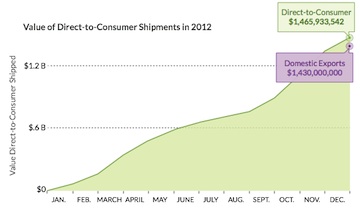 into account the value of wines shipped direct from wine retailers (brick and mortar retailers, Internet retailers, auction houses, wine-of-the-month clubs) to consumers. There is no data available for this particular channel. However, just one online retailer, Wine.com, has reported selling $60 million in wine in a single 12 month period. And this is but a fraction of the amount of wine shipped by retailers to consumers annually, given the proliferation of wine retailers that ship wine direct to the consumers.
It is not unreasonable to believe that the size of the overall wine shipping marketplace (including retailer shipping) reaches north of $3 Billion annually.
Now, keep in mind that the majority of growth in the direct to consumer shipping channel has occurred over the past eight years since the 2005 Granholm v Heald Supreme Court ruling. And consider still that in that time, various states have only opened slower for winery to consumer shipping. Consider further that even today only 15 states and the District of Columbia allow Retailer to consumer shipping.
Given this, you have to conclude that wine consumers in America have embraced the idea of having wine shipped directly to them (from various sources) with gusto and there is little sign they are ready back away from this embrace.
I’m of the belief that the room for growth within the direct to consumer shipping channel remains tremendous. Americans continue to indulge happily in online and mobile sales, creating a more and more firmly established proclivity to purchase wine remotely, and to receive the wine via shipment. Additionally, a few more states like Pennsylvania and Massachusetts will open their borders for winery to consumer shipping. And finally, retailers will eventually overcome the opposition posed by wholesalers, old school wine stores and some wineries to their own legal right to ship wine.
Is it possible that over the next ten years the total value of the consumer wine shipping channel (winery and retailer) could reach upwards of $8-10 Billion? Yes, it is possible assuming that legislative blockades and special interest concerns to not block progress in this channel. Additionally, there is every reason to believe that technological developments will make the online and mobile purchase of wine more convenient and easier to accomplish.


[…] Tom Wark offers his thoughts on the latest ShipCompliant/Wines & Vines Direct Wine Shipping Report. […]
The internet combined with society’s desire for simplicity, has devastated numerous monopolistic industries already–newspaper, print, advertising, movie, publishing, shopping, etc. It will now quickly do the same to three tier monopoly controlled and ancient alcohol distribution system. No longer will 6-8 enormous companies control 50-70% of all wine in the U.S. The consumer should and will be able to order from their tablet and have the wine delivered to their door. Looking forward to the future.
Cheers,
Martin
Martin A. Cody
President
Cellar Angels, LLC